The DTC Readiness Myth: Capability Matters More Than Company Scale
High-growth studios do not need publisher-scale teams to begin building a direct-player channel. They need one reliable operating loop: identify a meaningful player signal, deliver useful value, measure the response, and decide what to do next.
“Are we large enough for DTC?” is the wrong question
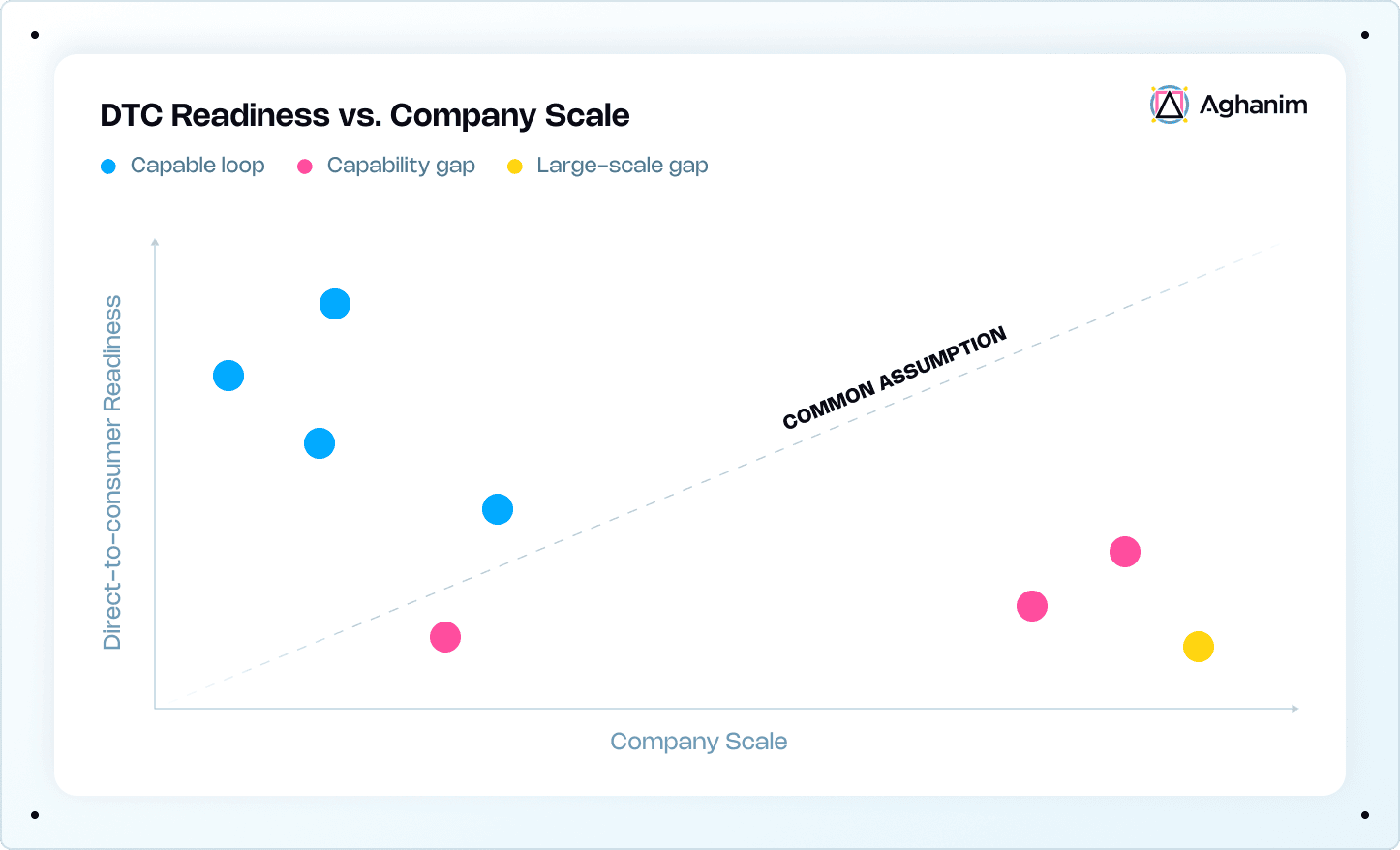
In conversations with game teams, DTC is often framed as a reward for organizational maturity, something to begin only after a studio has built a large audience, a dedicated web team, advanced analytics, and the legal and operational capacity to serve players globally. That sounds prudent, but it creates a paradox. The teams that need leverage most are asked to wait until they no longer need it.
Waiting costs more than delayed DTC revenue. Starting earlier can increase retained revenue, create more room for UA, and accelerate the learning needed to improve the channel. The impact varies by title and execution.
High-growth conditions rarely arrive in sequence. Audience size can outpace infrastructure. A creator campaign can bring in a new regional cohort before local commerce operations are ready. A live event can create a highly engaged cohort before CRM, community, and commerce systems can recognize the same player. The practical question is not whether the organization looks mature enough. It is which direct-player capability is constraining the next stage of growth.
Growth often outpaces operating maturity
In fast-growing game markets, opportunity often expands faster than organizational capacity. A studio can build a large audience while still relying on app store dashboards, fragmented community channels, and manually run campaigns. Product growth is easy to see. The operating gaps behind it often remain hidden until the studio tries to connect identity, engagement, community, and commerce.
That gap becomes visible when the studio needs to recognize and serve the same player consistently across the game, its community channels, and its direct commerce experience. The team can run an in-app event, yet struggle to continue the player journey after the session ends. When the studio enters a new market, checkout localization, tax operations, fraud controls, refunds, chargebacks, and player support can create a substantial new operating burden.
High-growth studios need operating leverage
These conditions are not unique to one geography. They appear wherever user growth, payment diversity, and competition outpace organizational capacity. Lean teams do not need to build every specialist function internally. They need operating leverage that lets them run more sophisticated player journeys without building separate web, CRM, payment, and compliance organizations.
That operating leverage depends on several capabilities working together:
- persistent player identity across the game and the web;
- a game hub that extends the player experience into the browser;
- segmentation and event-driven liveops journeys;
- game-specific offers and checkout experiences adapted to each market;
- a clear Merchant-of-Record model for tax, fraud, refunds, and chargebacks; and
- a measurement that separates genuinely incremental value from revenue merely shifted between channels.
None of these capabilities creates much value in isolation. Their advantage comes from operating as one continuous player journey.
This is also what separates a game hub from a checkout page. A checkout page moves a transaction to the browser. A game hub connects identity, content, community, liveops, loyalty, and commerce into a repeatable player experience.
For example, imagine a mid-sized live game gains a fast-growing cohort after a creator campaign. Without an owned destination, the studio is largely limited to buying more traffic or broadcasting generic messages. With a connected game hub, it can welcome that cohort, test localized experiences, and observe which journeys create repeat engagement.
Start with one controlled player journey
Direct-to-consumer should not begin as a large transformation program. It should begin with one controlled player journey and one decision. Reactivate lapsed payers, improve event participation, reward a guild objective, or create a better first-purchase experience in one priority market. The first test should demonstrate that the team can move from a player signal to a relevant experience, measure the outcome, and iterate. That learning loop is the foundation. Infrastructure matters because it makes the loop faster and more reliable; it is not the end goal.
The strategic question is therefore not “Are we large enough for DTC?” It is “Which direct-player capability is limiting our next stage of growth?”
Measure readiness by the speed and quality of learning
In this model, speed becomes a strategic capability. Time to launch matters, but time to learn matters more. A page deployed quickly without producing a decision is only fast production. A useful DTC capability shortens the distance from player behavior to validated action. That advantage compounds because every campaign leaves behind a better segment, template, rule or understanding of player value.
For a lean team, the goal is not to recreate a global publisher by adding headcount. The studio should retain control over the decisions that differentiate it, including player value, game economy, creative, timing, and brand, while relying on integrated infrastructure for complex but less differentiating work such as commerce operations, tax, fraud controls, refunds, chargebacks, and reusable campaign tooling.
The concern that DTC may become a second product is valid. A poorly scoped program can create its own backlog, vendor complexity, and support burden. The solution is not indefinite delay, but a tightly bounded first proof.
Before building further, a team should know the answers to four questions:
- Which player behavior are we trying to change?
- What value does the player receive even if they do not purchase?
- Which systems and responsibilities must be connected for this journey alone?
- What evidence will tell us to scale, adjust, or stop?
If the answers require an organization-wide transformation, the scope is too broad. If they describe one meaningful journey with clear boundaries, the studio may be more ready than it assumes.
Readiness begins with one useful loop
DTC readiness is not a milestone a studio reaches after achieving publisher scale. It is an operating capability built by repeatedly closing the loop between player behavior, player value, measurable evidence, and validated action. Studios that learn this early do not need to wait for publisher-scale infrastructure. By closing one useful loop at a time, they can begin building publisher-scale operating leverage with a far leaner organization.