Localization Is a Distribution Variable, Not a Translation Task
Mobile game growth no longer comes from a few default markets. Studios making meaningful revenue now operate across Southeast Asia, Latin America, Eastern Europe, and MENA, markets with high engagement and very different language expectations. They monetize well, but they do not respond to default English campaign logic as if they were one market.
Most studios met that expansion first with localized pricing and regional payment methods. Both make sense. They remove financial friction at the point of purchase. They are also only part of the problem.
The interface a player sees is part of the channel's performance too. Every offer, every notification, every game hub screen. And it usually gets far less discipline than the pricing layer beneath it.
Localization as a Distribution Variable
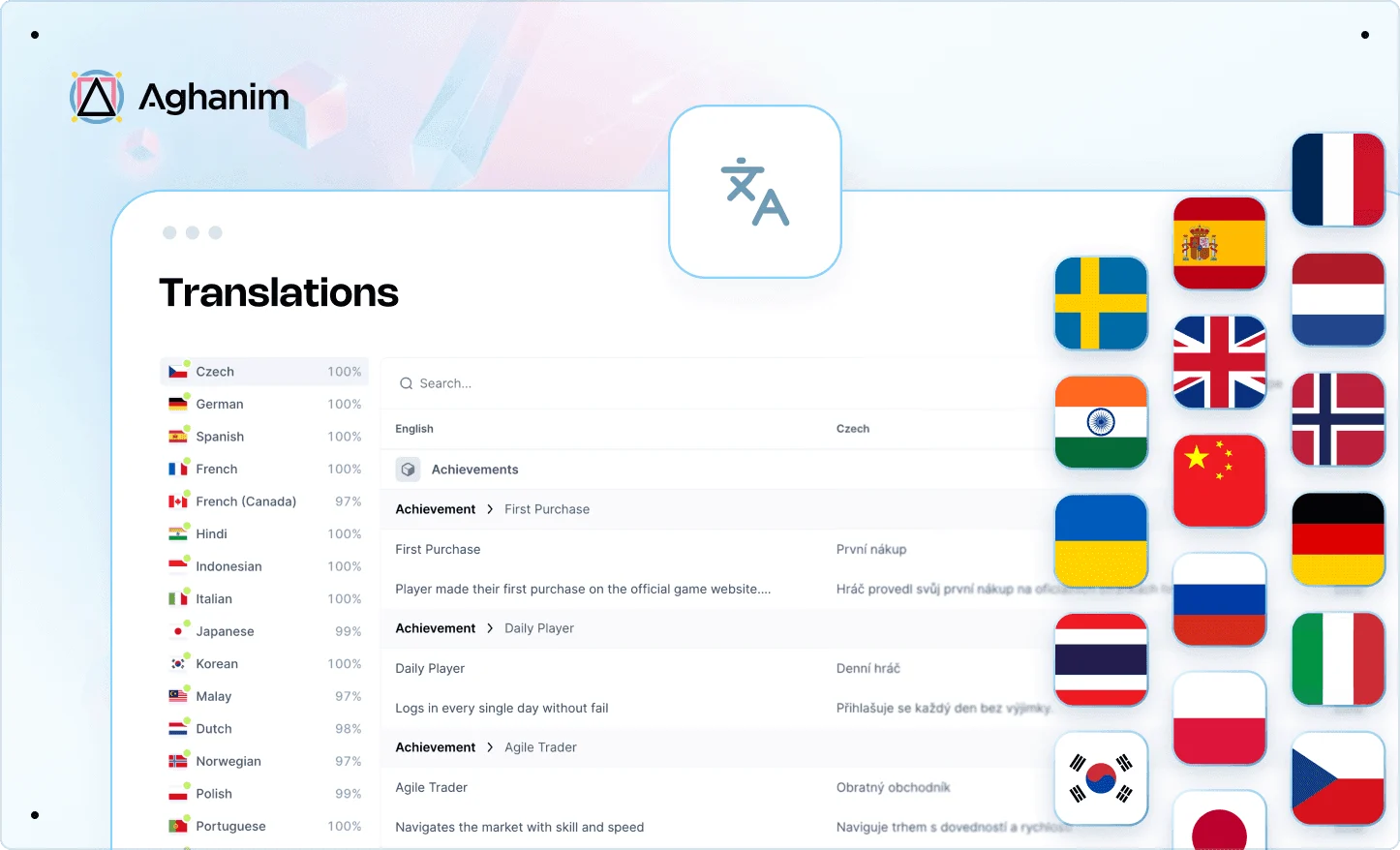
Localization works differently in a DTC channel than in a shipped game build. A build is localized by release cycle. A game hub has to be localized continuously.
Liveops content in the game hub runs weekly or faster. Campaigns, limited time offers, push notifications, loyalty prompts, popups. Each update is another moment where the studio asks the player to understand, click, return, or buy.
When that content reaches a player in a language that feels generic, awkwardly translated, or culturally flat, the conversion economics shift. Not dramatically in one instance. Consistently, across touchpoints and campaign cycles. The loss rarely shows up as one obvious failure. It shows up as lower click through, weaker offer comprehension, and more drop off across repeated campaigns.
This is not only a translation quality problem. It is a distribution problem. Liveops localization shapes DTC performance because it interacts with offer timing, segmentation, and player behavior. Studios that treat it as a downstream task usually find its impact only after the pattern is already in the data.
The Scale Problem With Manual Localization
At low volume, manual workflows are manageable. A campaign is created, sent to a vendor or internal team, reviewed, and deployed. The process works. It just adds time. Liveops campaigns are time sensitive by nature, and an offer that lands three days late because localization was the bottleneck has already lost part of its conversion window.
At higher volume, the friction is harder to hide. Promo calendars compress. Testing cycles speed up. Segmentation models evolve. The demand on localization grows, and the workflow behind it often does not.
So studios start to triage. Some markets get full localization. Others get adapted English, or the last campaign's translation is reused without adjustment. The channel still makes revenue, but unevenly across regions. And the markets with the most language friction are often the ones with the strongest growth potential.
If localization cannot move at liveops speed, market coverage becomes theoretical.
Where Localization Changes Performance
Localization matters most when the DTC channel becomes an operating surface. A studio running a web campaign may need to localize:
- a limited time bundle title and urgency copy
- loyalty reward descriptions
- cashback rules
- push or email reminders
- checkout adjacent explanations
- creator or event specific campaign pages
- regional purchase and tax messaging
Each item looks small on its own. Together, they decide whether the game hub feels like part of the game economy or like a generic external page.
What Language Friction Costs
Take a time limited bundle launched across five markets for instance. The offer is identical. Same price, same reward structure, same 24 hour urgency. But if one market gets native language copy at launch while another gets adapted English, or a translation two days later, the campaign is no longer being tested on equal terms. The studio is no longer comparing market demand. It is comparing operational readiness.
In that setup, localization touches three measurable points. Offer view to click, cart start, and purchase completion. Even when the exact revenue delta stays hidden, the funnel shows where language friction enters the purchase path.
A player who does not fully understand an offer is a player who pauses. In a purchase flow or a limited time offer, a pause is a conversion event. Cognitive friction and financial friction do the same thing. Both raise abandonment at the point of decision.
Liveops is where a DTC channel becomes a habit, or fails to become one. Players come back to a game hub when the experience is coherent, relevant, and timed to their context. Localization is part of that coherence. When it is inconsistent across markets, habit formation is inconsistent too, and so is the channel's revenue.
The Question Teams Ask Too Late
Liveops localization usually gets treated as content production, handled by the same team building campaign assets. Whether it can support the markets being served tends to surface only after something breaks.
By then, the pattern has been running for quarters. The cost is already buried in the data.
What teams should ask earlier is whether the channel can localize as fast as it operates. If campaigns deploy in hours but localization takes days, the channel is throttled by its own workflow. The same goes for payment flexibility, pricing experimentation, and segmentation depth. Each decides whether a DTC channel can be managed, not just launched.
SuperPlanet launched 10 game hubs with Aghanim in less than 30 days, with K-Devil Hunter reaching 48% web revenue share in less than 30 days. They show why routing, liveops, payments, compliance, and localization matter once DTC becomes a managed channel.
Key Takeaway
Localization in DTC is not a one time translation task. It is a performance variable. The markets where mobile games grow fastest are often the ones where the gap between a studio's assumptions and the local player experience is widest, and liveops is where that gap gets closed or left to persist. Built into the game hub, localization stops being overhead and becomes part of distribution. Bolted on later, it becomes the constraint on how fast and how wide the channel can grow.