The Cost of Not Launching DTC for Game Studios
For mobile game publishers, the conversation around direct-to-consumer almost always starts with cost. How long will integration take? How much internal support will it require? What does the vendor charge? Will the team need to rework payments, offers, liveops, CRM, and support flows?
Those are sensible questions. But they are not the most expensive ones. The bigger question is what it costs to not launch DTC at all.
That cost rarely shows up as a line in the P&L, which is exactly why it gets underestimated. Yet it is real, recurring, and cumulative. Every month a game stays fully dependent on the mobile stores, it pays higher fees than a direct channel would, keeps less of each payer dollar, and leaves the direct-channel upside on the table.
Why “do nothing” is not neutral
For years, many studios treated DTC as an advanced project reserved for the largest publishers. That made sense when launching a DTC channel meant building custom infrastructure and absorbing real operational complexity. That picture has changed. Web commerce tooling for games has matured, and direct channels are now common across the top-grossing market.
That shift matters because it moves the benchmark. Once DTC becomes normal market behavior, staying store-only is no longer the safe default, it becomes a choice to keep all revenue in the stores, even when a direct channel would keep more of it. In other words, not launching DTC is not passive. It is a decision to preserve lower margins.
The mistake in most DTC models
A lot of DTC arguments lose credibility because they lean on unrealistic math. They imply that the moment a publisher launches a web store, a huge share of revenue abandons the app stores overnight, or that nearly all DTC revenue should be treated as pure upside. That is not how spend actually migrates.
A better model starts with something more practical: partial migration. Not 100%. Not fantasy adoption. Just realistic scenarios where some share of existing payer spend moves from the stores to the web over time. That is the right lens for an executive team, because it reflects what DTC really does in most organizations. It does not replace the stores; it creates an additional channel that gradually takes a meaningful share of spend, improves margin on that share, and opens room for better merchandising, CRM, and web-native offers.
An illustrative DTC revenue model
Take a mobile game with $10M in gross annual sales, currently monetized entirely through Apple and Google. Store fees vary by platform, market, and purchase flow, so there is no single rate. For illustration, say the store channel costs 30% and the direct channel 7.5%, a 22.5-point gap on whatever spend shifts to DTC. Actual economics will vary.
So every dollar that moves to DTC keeps an extra 22.5 cents after fees. Rather than assume all spend migrates, consider three scenarios:
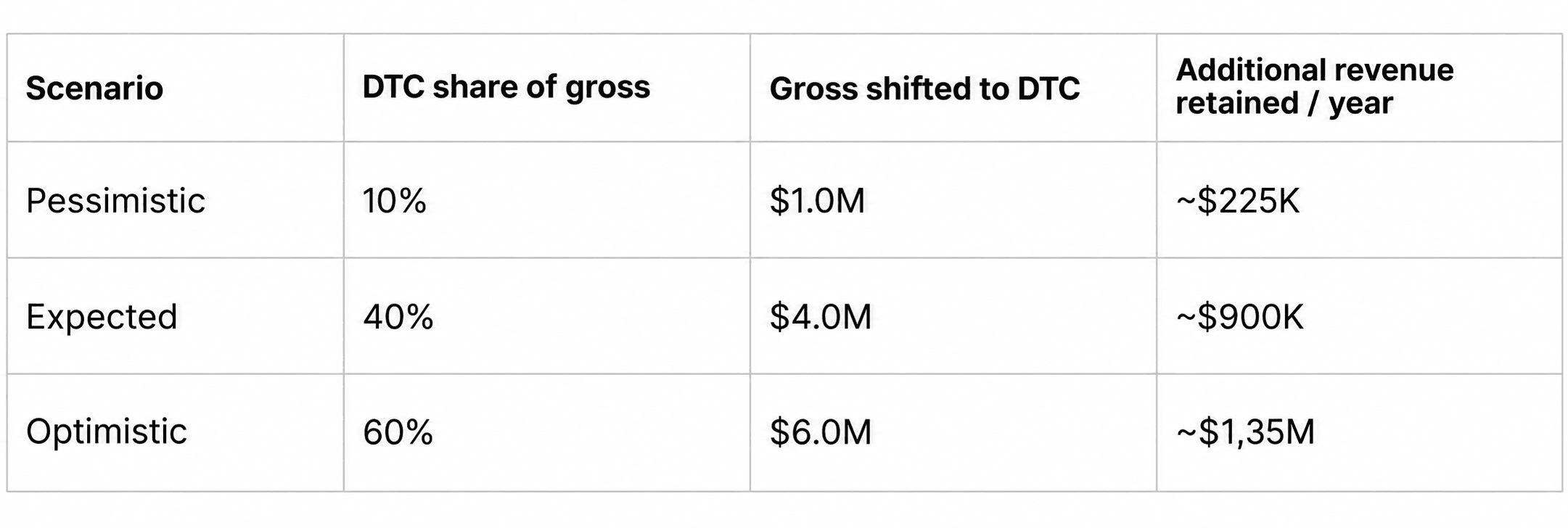
These are not gross revenue estimates. They are the extra money the developer keeps because the direct channel costs less than the store, money that stays in their pocket rather than passing through checkout.
At the pessimistic end, only 10% of spend moves, just $1M in volume, and it still leaves about $225K a year. The expected 40% shift produces roughly $900K, worth capturing without inventing a new audience. The optimistic 60% yields about $1,35M.
And 40-60% is not a stretch. Across a number of partner titles using Aghanim, direct-channel share has reached the 40-60% range once loyalty, segmentation, and liveops were layered onto the experience. Results vary by title, audience, and operating model, so this range should be treated as directional rather than universal.
Why the upside goes beyond commissions
Even this model is conservative. It counts fee savings, not the spend DTC can unlock.
DTC does not only help publishers save on store fees. It often creates a higher spending environment. A branded hub allows stronger bundles, more flexible pricing, cleaner merchandising, and more direct promotions than the native store flow. The same player, given relevant offers and an easier checkout, often spends materially more than they would in-store.
The other common objection is cannibalization, the fear that a game hub simply reshuffles existing spend with no net gain. Results push back. In this case study, a publisher’s game hub reached 44% of total IAP revenue across platforms within eight days, with hub ARPPU above in-app levels and no observed drop in store purchases. The game hub added direct-channel revenue rather than moving it. So the cost of not launching DTC is not only the margin lost to fees. It is also the incremental revenue you never unlock because your best payers are never exposed to a stronger purchase environment.
DTC can expand your user acquisition capacity
There is a second-order benefit on the acquisition side, and it is simple. When you keep more of what a player spends, you can afford to spend more to bring the next one in.
User acquisition is an auction, and what you can profitably bid for a player depends on what that player is worth to you over time. Keeping more revenue on the spend that moves to the direct channel raises that figure. Add the extra spend a game hub tends to bring in through better offers, loyalty, and liveops, and a player’s lifetime value can rise further still.
The result is more room to grow. A publisher that keeps more per player can reinvest more in acquisition while holding the same return targets. How much more depends on DTC penetration, payer mix, and how much extra the direct channel earns, but the direction is consistent.
The opportunity compounds over time
This is why timing matters. The cost of launching DTC is mostly finite: integration, setup, process changes, and some ongoing operational work. The cost of not launching is recurring, and it compounds every month a title stays structurally dependent on the store layer.
Using the scenarios above, the opportunity becomes meaningful once DTC adoption reaches scale. At a 20% DTC share, the illustrative model implies about $450K in additional revenue retained on an annualized basis. At a 40% share, that figure rises to about $900K. Actual first-year impact will depend on how quickly player spend shifts to the direct channel.
Integration is no longer the hard part
One reason the “can we afford the integration?” question lingers is an outdated picture of what integration costs. Aghanim ships first-class tooling for AI coding agents, so much of the backend work now happens inside the developer’s own editor, Claude Code, Cursor, VS Code, and other MCP-aware assistants, rather than as a separate vendor project bolted onto the roadmap.
Critically, the agent isn’t guessing. Through Aghanim’s Newton MCP server it reads the live product docs and current API schema as its source of truth, then scaffolds the required server-to-server webhook handlers, player verification, item grant, and item removal, complete with signature verification and idempotency. It also generates and runs end-to-end tests that exercise the integration against signed Aghanim payloads. For Claude Code, Aghanim offers a one-command plugin install that bundles Newton MCP, the webhook quick-start skill, and the matching slash command. Together, these cut the manual engineering work and shorten the path to launch.
The people matter as much as the tooling. Aghanim’s producer team does not operate as an arm’s-length vendor that hands over a dashboard and waits for tickets. They work as an extension of the developer’s own monetization and integration team, absorbing the routine operational load: campaign setup, offer configuration, A/B test design, pricing maintenance, and the day-to-day liveops cadence. The studio keeps strategic control while offloading the repetitive work that otherwise makes a direct channel feel expensive to run.
That reshapes the cost side of the equation, not just the revenue side. The “we don’t have the engineering or liveops bandwidth” objection, the common reason teams delay, stops being a blocker.
The real executive question
So the core question should change.
It is not “Can we afford the integration?” For many teams, integration is now a smaller part of the decision. The real question is the one almost no one asks out loud: “How much are we already paying, every year, for not having DTC?”
That cost compounds. Launching DTC requires upfront investment and ongoing operational work. But the opportunity cost of delaying can also accumulate over time as potential direct-channel revenue remains unrealized. For a $10M mobile game, the scenarios above suggest an annual retained-revenue opportunity of roughly $225K to $1,35M, depending on how much player spend shifts to DTC. And that still excludes the upside from better CRM, stronger direct player relationships, and higher web monetization.
Framed that way, DTC is less about the cost of adding a channel and more about improving channel economics, deepening player relationships, and building monetization capacity over time.