Why Direct Checkout Alone Is a Lame-Duck Strategy and Game Hubs Are the Future of Mobile Game DTC
The first DTC breakthrough
For the last year and a half, direct checkout looked like the purest expression of DTC in mobile games. The logic was clean: trigger an alternative payment flow straight from the in-game store, move the player off the platform's billing rails, and keep the margin that in-app purchase used to take.
For producers, this lived right at the moment of intent, it could be dropped into the store flow, paired with a tailored offer, and run as a real revenue lever rather than a distant "web experiment." For a while the deal was almost too good: in markets like the United States, developers could route purchases to the web without a platform commission. On iOS, that remains true for now, pending the district court's decision on Apple's proposed fee.
Why that moment is fading
That model still works, but its strategic edge is eroding fast, and the reason is the same force that created the opening: regulation.
Since 2024, antitrust pressure and new competition laws have pushed Apple and Google to allow external links and alternative billing. The door opened. What most teams underestimated is what happened next: the platforms accepted alternative checkout as a reality, then redesigned their economics so it stays possible while still carrying platform fees. Openness did not mean fee-free. It meant a new fee structure, and across every major market, it is moving in one direction.
The EU set the pattern, mirrored in other markets
The Digital Markets Act in the EU set the regulatory direction. Apple and Google were required to permit greater steering and alternative payment options, while introducing revised commissions and technology fees under their respective frameworks. External payment routes therefore remain available, but they may still carry platform fees. Similar models have since emerged in other major markets under new competition legislation.
Japan
The Mobile Software Competition Act took full effect in December 2025, and Apple's compliance framework spelled out the new math: developers can link players out to a website, but Apple charges 15% on transactions made within seven days of the link tap, up to 21% on in-app alternative payments, and a 5% Core Technology Commission for apps distributed outside the App Store through alternative marketplaces. In practice, greater openness did not mean zero platform fees.
Brazil
Apple's full Brazil framework went live in mid-June 2026 after a binding antitrust settlement. Under it, an app can show static text pointing users to pay on the web without a fee, while tappable link-outs carry a 15% Store Services Fee, reduced to 10% for eligible smaller developers. Apple's separate 5% Core Technology Commission applies to apps distributed outside the App Store, not on top of the link-out fee. The external link survives; the "no fees" version of it does not.
The US: Google closes the gap
The US was the last big market where direct checkout still felt close to free, and that advantage is now narrowing. From June 30, 2026, Google's new Play Store fee structure applies in the US, UK, and EEA. The service fee starts at 10% on the first $1M in annual earnings regardless of whether the transaction uses Google Play Billing, alternative billing, or an external web link. Above that threshold, standard non-recurring transactions carry a 20% service fee on new installs; for existing installs, Google lists 25% for in-app or alternative-billing transactions and 20% for external web links. Google Play Billing adds a separate 5% billing fee where applicable. Effective October 1, 2026, developers enrolled in the US external content links and alternative billing programs must report transactions and pay fees under the new fee structure. In response to a court order, Apple has proposed commissions of up to 15% on US link-outs, subject to further court proceedings. The fee-free link-outs era is increasingly under pressure in the US.
Why direct checkout becomes a tactical play
Put the markets side by side, and the pattern is unmistakable. Japan, the EU, Brazil, and now the US are converging on the same answer: the platforms are allowing developers to route transactions outside their billing systems while retaining a share of the underlying economics.
Direct checkout is not dead. It still buys merchandising control, pricing flexibility, and in many markets a cheaper, smoother purchase path than default billing. But its core promise, step outside platform economics entirely, is gone. When the platform captures a meaningful share even on an external link, direct checkout stops being a moat and becomes a partially cheaper route inside the platform's economics. That makes it tactical: it can optimize a purchase moment, but it cannot, by itself, carry a long-term DTC strategy. Build your whole thesis on a single checkout mechanism, and your business case remains highly sensitive to the next fee table the platforms publish.
Why game hubs matter more
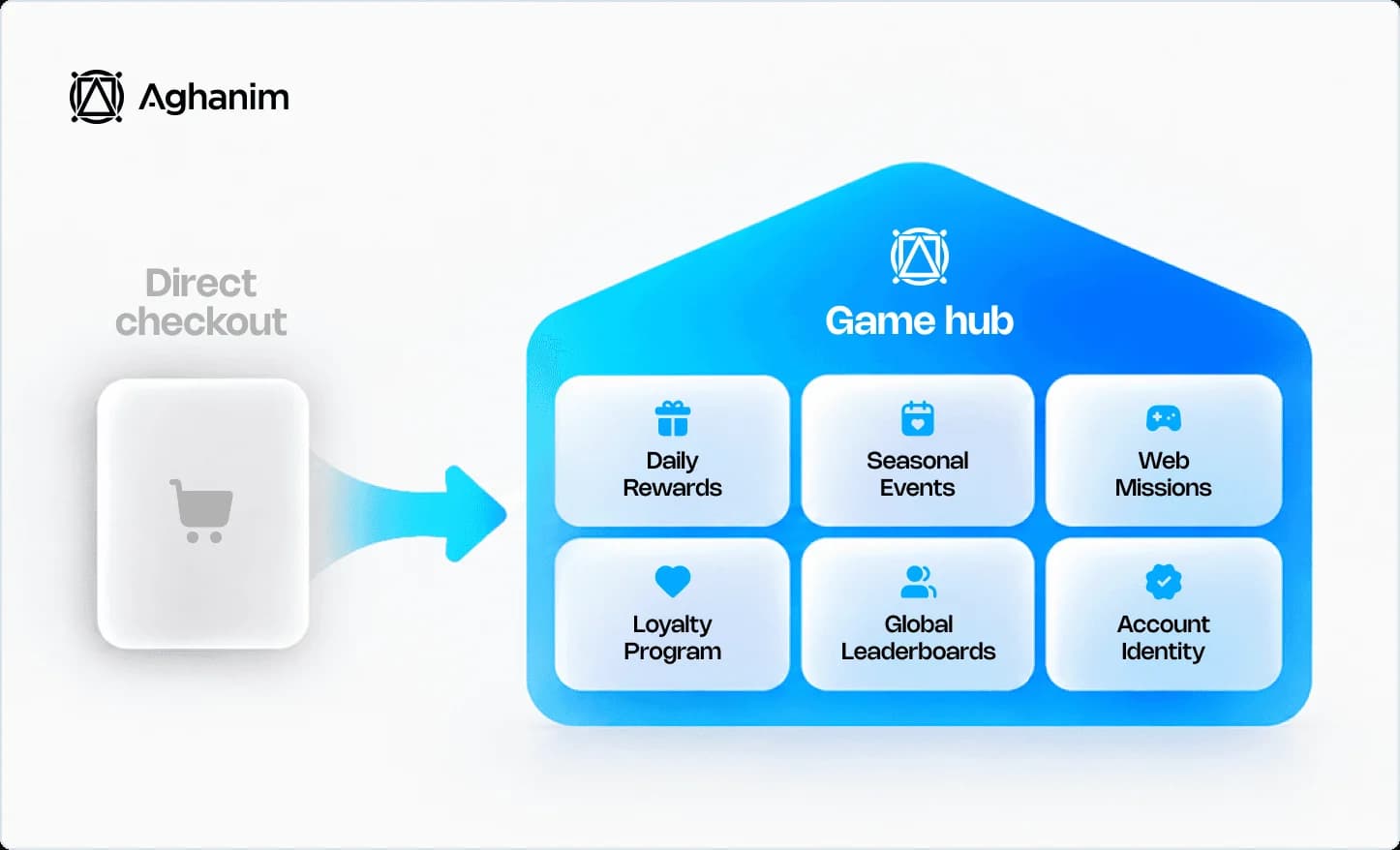
This is where game hubs become strategically important. A game hub does not depend on any single checkout mechanism or regulatory framework. It is an owned environment where monetization is one component of the value, not the whole of it. Personalized offers, progression-linked rewards, event pages, loyalty and cashback, web missions, social layers, account identity, and CRM capture all live in a single branded destination. Together, they create repeat engagement loops that give players reasons to return beyond making a purchase. When a platform changes its fee schedule, it can dent the payment economics, but it cannot touch the retention, the conversion lift, the larger baskets, or the direct player relationship the hub creates.
This is the move from margin arbitrage to value creation. The first generation of DTC was arbitrage: move the transaction off the store and pocket the difference. As that difference gets taxed away, the next generation has to be built on something the platforms can't price: an owned layer that gives players better reasons to come back, spend, and stay connected. The right question is no longer "how do we bypass store fees?" but "how do we build a destination that grows lifetime value even if store fees never go to zero?" Game hubs answer that better than checkout alone because they are not checkout infrastructure. They are product infrastructure.
The only zero-commission link-out that survives
There is a sharper way to see why this matters. As the fees above make clear, what the platforms actually tax is the transactional link-out: a button that sends a player straight to a payment for digital goods. A player visiting a branded web destination through independent channels is a fundamentally different relationship, one that does not depend on a transactional link-out from the app.
That makes a well-executed game hub a durable destination for building a direct player relationship beyond any single checkout route. Players arrive through channels the platforms don't gate: owned marketing, web and social, email and CRM, organic search, cross-promotion. Inside the hub, they engage, build an account, claim rewards, and yes, transact, but as visitors to your property, not as a taxed in-app checkout event. Done right, the hub is not a way to route a single purchase around a fee. It is an owned destination where the player relationship extends beyond any single platform-controlled transaction.
Why producers should act now
Keep using direct checkout where it improves economics and UX, but don't mistake it for the end state of DTC. The end state is an owned player ecosystem, and public case data already shows the potential. In DECA Games' Celtic Heroes case, a game hub generated 44% of total IAP revenue within eight days, with zero cannibalization of mobile purchases. One in three visitors converted to a purchase, while hub ARPPU reached 183% of the in-app average. The leaders in mobile publishing are already moving meaningful revenue through the web, and they are not doing it on a checkout button alone.